The Only Approved Drug for This Kidney Disease Never Faced the Usual First Choice
The FDA cleared obinutuzumab for primary membranous nephropathy on a 37% to 6% complete remission win over tacrolimus. Rituximab, the drug most nephrologists reach for first, was never in the trial.
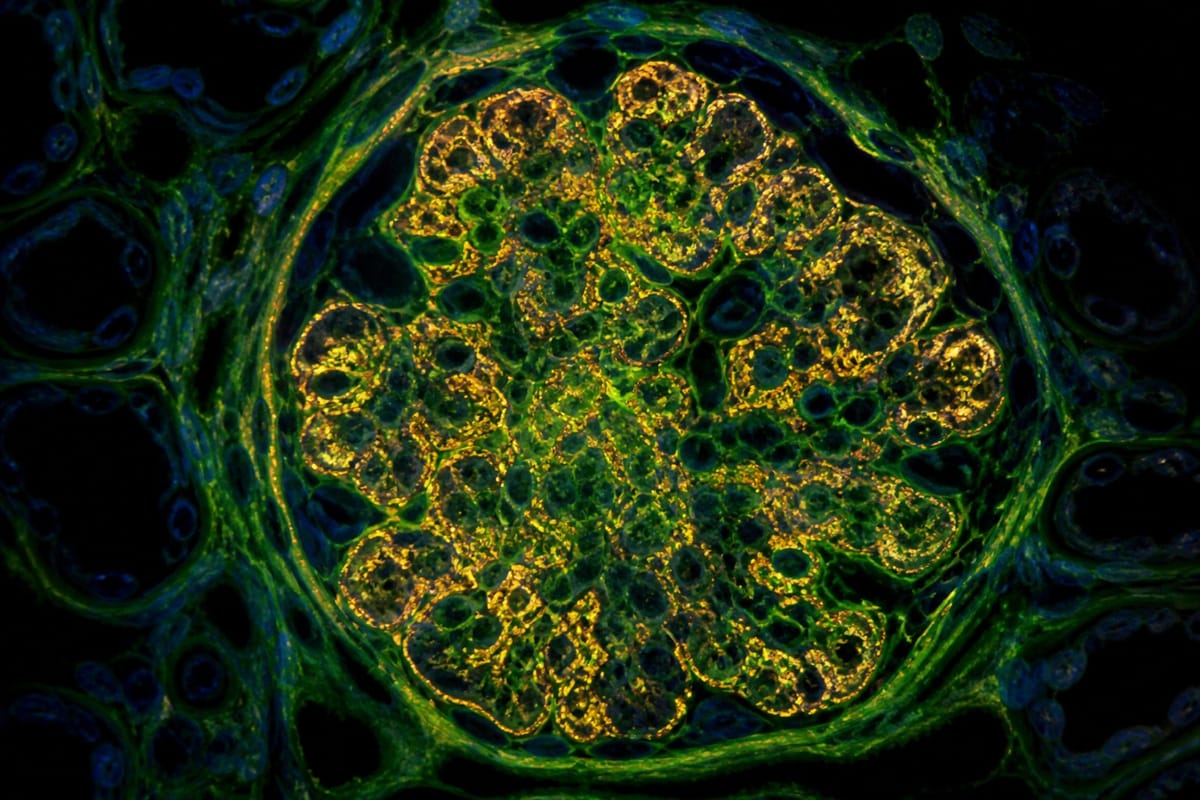
On Sunday the FDA approved Gazyva, Genentech's obinutuzumab, for adults with primary membranous nephropathy at risk of disease progression, making it the first and only therapy ever cleared for the condition. The number behind the approval looks lopsided: 26 of 71 patients on Gazyva reached complete remission of proteinuria at week 104, against 4 of 70 on tacrolimus.
A real result in a disease managed with off-label drugs and watchful waiting for decades. It is also a result built on a comparator most American nephrologists do not reach for first.
What MAJESTY measured
The trial behind the approval was a phase 3, randomized, open-label study that enrolled 142 adults and assigned them one to one to obinutuzumab or tacrolimus. The primary endpoint, complete remission of proteinuria at week 104, came in at 37% versus 6%, an adjusted difference of 31 percentage points with a 95% confidence interval of 18 to 44.
Two further endpoints favored obinutuzumab: complete or partial remission at week 104, and complete remission at week 76. Then the sequence broke. A sustained reduction in eGFR of at least 30%, the first endpoint meant to show the drug protects kidney function, not just protein levels, did not reach statistical significance, so later endpoints went untested. The data were presented as a late-breaking oral at the European Renal Association congress and published in the New England Journal of Medicine.
The competitor that was not in the room
What the trial cannot tell you is how obinutuzumab compares with rituximab, the other anti-CD20 antibody used in this disease. A 2024 treatment standard published in Nephrology Dialysis Transplantation describes rituximab as favored as part of initial therapy, with calcineurin inhibitors an option that carries a higher risk of relapse after withdrawal. Rituximab has no approval in this disease, so it is used off-label, but off-label and unused are different things.
The historical numbers sharpen the point. In the MENTOR trial, rituximab beat cyclosporine on complete or partial remission at 24 months by 60% to 20%, with fewer adverse events. MAJESTY's tacrolimus arm produced complete remission in 6% of patients at two years, while MENTOR's cyclosporine arm reached complete or partial remission in 20%, a looser measure. Different trials, different endpoints and different eras, so this is not a like-for-like comparison. Even so, a meaningful slice of MAJESTY's 31-point separation comes from how poorly tacrolimus performed, not only from how well obinutuzumab did. No trial has put obinutuzumab up against rituximab.
What approval actually changes
Plenty, starting with coverage. An on-label indication gives nephrologists a therapy they can prescribe without justifying it to a payer as an experiment, and it gives patients a labeled safety profile instead of a literature review. The FDA had already granted it Breakthrough Therapy designation.
It is also consistent with the mechanism. Primary membranous nephropathy is driven by autoantibodies against podocyte antigens, and depleting the B cells that produce them attacks the disease at its source rather than suppressing the immune system broadly. This is the third approval for Gazyva in immune-mediated kidney disease, after idiopathic nephrotic syndrome and lupus nephritis. The FDA is weighing it in systemic lupus erythematosus, with a decision expected by December, and Genentech says it is submitting the kidney data to Europe's regulator.
The questions two years cannot answer
MAJESTY followed patients for 104 weeks. Membranous nephropathy is a lifelong condition with a relapsing course, and monitoring guidance for anti-CD20 therapy calls for checking antibody titers and B-cell counts every three to six months and re-treating when the counts or titers move the wrong way. That schedule exists because response is not always durable. Whether obinutuzumab holds remission longer than rituximab, and whether either changes the trajectory toward kidney failure in the up to 30% of untreated patients who progress within a decade, will take years of follow-up.
Safety looked comparable in the trial. Serious adverse events ran 17% on obinutuzumab against 14% on tacrolimus, with serious infections at 3 versus 4 per 100 patient-years. The label still carries the class warnings: infusion reactions, hepatitis B reactivation, progressive multifocal leukoencephalopathy, and a note that patients on Gazyva may face higher risk of severe infection than those on tacrolimus. With an estimated incidence of 1.2 per 100,000 people a year in the United States, those belong in the conversation before the first infusion.
The approval settles one argument: membranous nephropathy deserves a labeled therapy. It leaves the more interesting one, about which B-cell drug to use first, exactly where it was.