Medtronic's Hugo Wins a Label Covering 3.5 Million Surgeries a Year
The FDA cleared Hugo for general surgery, opening about 3.5 million U.S. procedures a year. The installed base and the training pipeline decide whether that becomes cases.
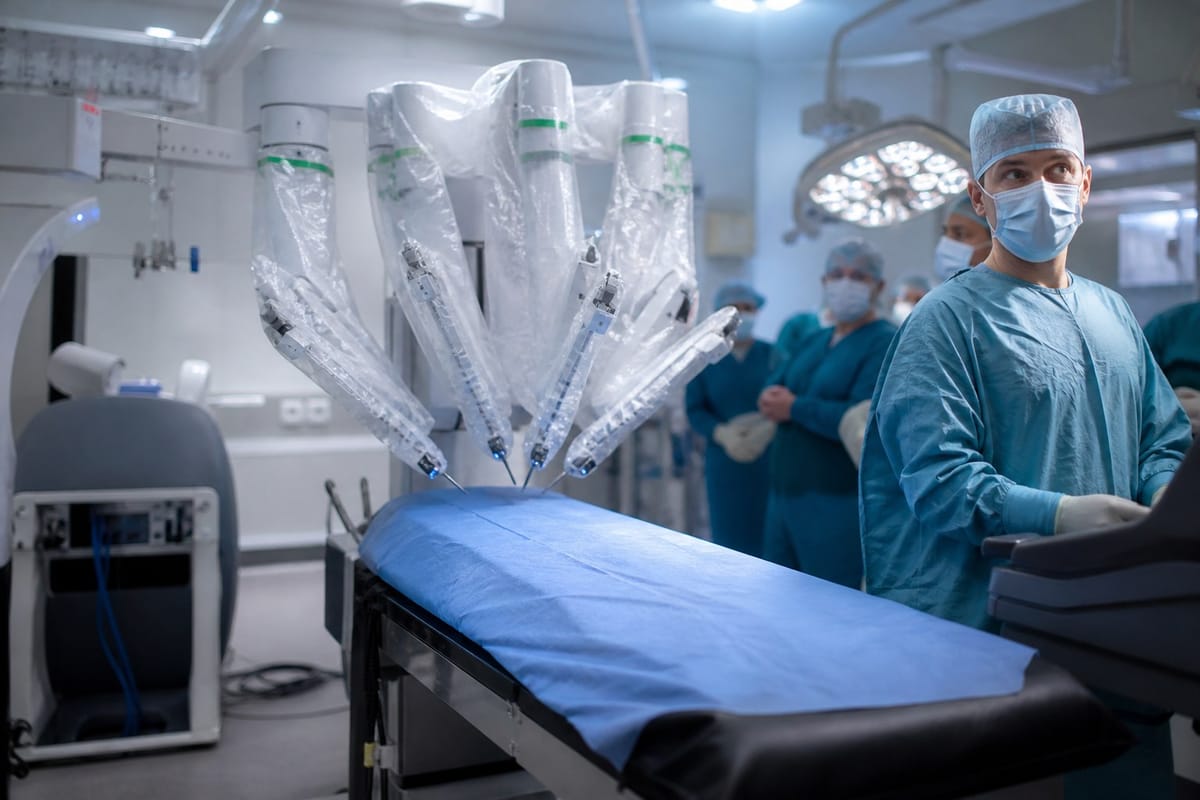
Medtronic says the U.S. procedures its Hugo robot just won clearance for add up to about 3.5 million surgeries a year, more than half of all soft-tissue operations performed in the country. The FDA cleared Hugo for general surgery on 17 November 2026, covering upper abdominal work from cholecystectomy and Roux-en-Y gastric bypass to ventral hernia repair and small bowel resection, plus inguinal hernia and appendectomy lower in the abdomen.
The practical effect is that a system cleared only for urology in December 2025 now qualifies for most of the American soft-tissue market. That is permission to sell, and permission is the cheapest part of surgical robotics. What turns a general surgery label into a general surgery business is consoles, trained teams and case volume.
What the hernia portion rests on
The hernia half of the label leans on the Enable Hernia Repair study, a prospective, multi-center, single-arm pivotal trial of 193 patients and the first IDE study of robotic hernia repair run in the United States. Surgical success came in at 100% against a pre-specified performance goal of 85%. Surgical site events were 0.0% among the 92 inguinal patients analyzed and 2.1% among the 94 ventral patients, each measured against a 30% goal, and the two ventral events resolved without complication. Mean hospital stay was 4.7 hours for inguinal and 6.7 hours for ventral patients.
Those are single-arm results judged against performance goals, not against another robot or an open repair. The trial, NCT06445504, is listed as active and not recruiting, with completion expected in March 2027, when longer follow-up in a U.S. population starts to arrive. Meeting a pre-set bar is a different claim from beating an incumbent, and on that question there is no head-to-head evidence in either direction.
The arithmetic a label does not touch
Intuitive finished September with 12,094 da Vinci systems installed worldwide, up 12% from 10,763 a year earlier, and placed 546 systems in the third quarter alone, 315 of them da Vinci 5. Medtronic, by contrast, expects Hugo to pass 50,000 procedures globally by the end of its fiscal year, with growth faster than twice the robotic surgery market. Every da Vinci in service is also a training pipeline full of surgeons who already operate on it, which is a harder thing to replicate than a 510(k).
Demand is the part that is genuinely open. Medtronic puts robotic surgery penetration in the single digits worldwide and near 1% in emerging markets, with procedure volumes growing roughly 16% a year over the past decade. An underpenetrated market does not have to be taken from anyone, which is why Medtronic's pitch is capacity rather than superiority: modular arms, so a team uses only the arms a case needs, and an open console that keeps the surgeon connected to the operating team.
The filing itself moved briskly. Medtronic sent the general surgery 510(k) in late April 2026, making the review roughly seven months.
Three systems, one lane
General surgery is also the segment where a third vendor is already selling. Johnson & Johnson's Ottava, a table-integrated robot, took FDA De Novo authorization on 22 July 2026 for upper abdominal procedures including gastric bypass, cholecystectomy, splenectomy, small bowel resection and hiatal hernia repair, with an inguinal hernia trial still running. J&J puts its footprint 30% to 50% below boom- and cart-mounted systems, aimed at the same constrained operating rooms Medtronic is now calling on.
Intuitive's own quarter carried a reminder that this market has a history. Its $523 million in GAAP net income on revenue of $3.05 billion, up 22%, absorbed a $450 million pre-tax charge tied to a previously disclosed antitrust settlement. The near-term picture is plainer than the litigation: hospitals weighing a soft-tissue robot now have three vendors with U.S. general surgery authorizations instead of one.
What decides the next year
Three things to watch: whether Medtronic files Hugo for U.S. gynecology, which it has said is coming and which would widen the base again. Whether the Enable hernia data matures cleanly through 2027, the first real look at follow-up in American patients. And, least visible and most decisive, whether hospitals buy a second Hugo console for throughput, the behavior that built Intuitive's installed base and the surest sign a label is turning into cases.
The label, on this evidence, was the easier half. Medtronic has a robot that can legally be sold into most American soft-tissue surgery. The next twelve months will show whether hospitals want a third console in the room badly enough to retrain for it.