The Markers Moved. The Heart Attacks Didn't.
Two Phase 3 trials published Saturday moved their molecular targets exactly as designed, and neither prevented events. Pelacarsen cut Lp(a) 78.4%; ziltivekimab cut IL-6 76%. The full data show where cardiovascular drug development now stalls.
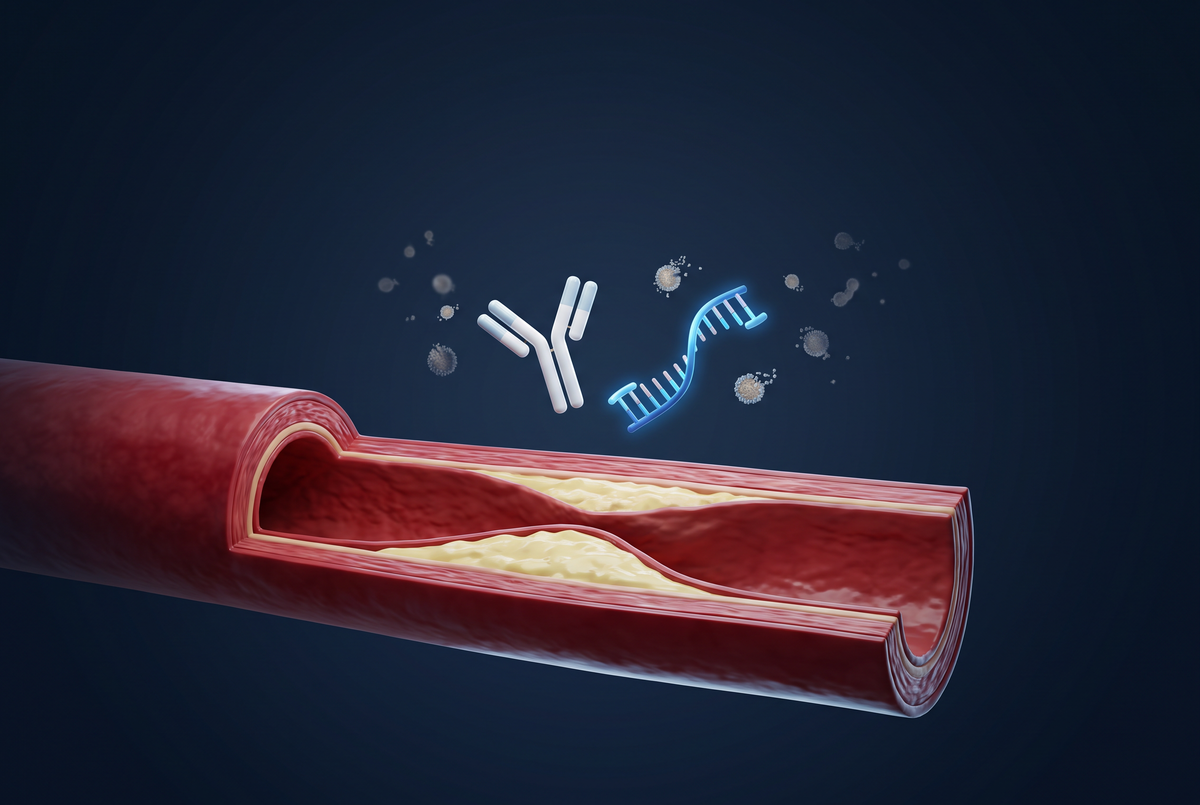
At the American Heart Association Scientific Sessions in Chicago on Nov 7, full results of two Phase 3 cardiovascular outcome trials were presented and simultaneously published in the New England Journal of Medicine. Both were neutral. The drug did precisely what its molecular design promised, and the heart attacks came anyway. The two failures mark the same boundary line: a genetically validated marker is not, by itself, a target that changes outcomes.
Lp(a) fell 78 percent. The events did not move.
Pelacarsen is an antisense oligonucleotide licensed from Ionis and funded by Novartis, built to block production of lipoprotein(a) in the liver. The Lp(a)HORIZON trial enrolled 8,322 patients with established cardiovascular disease and Lp(a) of 70 mg/dL or higher, median baseline 109 mg/dL, randomized from December 2019 through July 2022 across 797 sites in 42 countries. Patients injected 80 mg monthly under the skin, and the median follow-up ran 57 months, about 4.7 years.
The pharmacology worked. Pelacarsen cut Lp(a) by 78.4% at 12 months, while placebo rose 3.2%, and time-averaged Lp(a) over nearly five years fell 73.9%. LDL dropped to 62.3 mg/dL against 71.2 mg/dL on placebo. Outcomes did not budge. A first major cardiovascular event, a composite of cardiovascular death, nonfatal heart attack, nonfatal stroke, or urgent coronary revascularization, occurred in roughly 12% of both groups, 503 patients on drug versus 511 on placebo. In the even higher-risk subgroup with Lp(a) of 90 mg/dL or above, the rate was 12.3% in both arms. Extended analyses in NEJM Evidence were neutral across every combination examined, and senior author Steven Nissen of Cleveland Clinic said there there was "basically no effect on outcomes, not even a trend, even in subpopulations."
The inflammation hypothesis took the same blow
Novo Nordisk's ziltivekimab, a monoclonal antibody that blocks interleukin-6 signaling, ran the parallel test of the inflammation theory. The ZEUS trial enrolled 6,376 patients with atherosclerotic disease, clinically significant chronic kidney disease, and high inflammation, defined as hs-CRP of at least 2 mg/L, mean age 69, treated with a 15 mg monthly injection for a median of 33 months. The biomarkers fell exactly as designed: IL-6 down 76%, hs-CRP down 64% versus placebo. The clinical composite did not. There were 561 primary events, cardiovascular death, nonfatal heart attack, or nonfatal stroke, on ziltivekimab against 565 on placebo, and 538 all-cause deaths versus 542.
Lead author Paul Ridker of Harvard and Mass General Brigham did not surrender the thesis. He pointed to prior trials with canakinumab and low-dose colchicine that did reduce events, and argued the ZEUS population was too advanced for the intervention to matter, that targeting inflammation in this group may have been "too little, too late." His road map forward runs through NLRP3 inflammasome inhibition and IL-6 blockade in patients whose disease is caught earlier.
The same wall, hit from two directions
What the two programs share is evidence quality. Elevated Lp(a) levels are about 90% genetically determined, elevated in roughly one in five people worldwide, about 1.4 billion, and no approved therapy lowers it. Both had cleared every evidentiary filter short of an outcome trial. Both also saw their toplines months ago: ZEUS topline landed July 31 with a hazard ratio of 0.99, and Lp(a)HORIZON reported September 4. Saturday's papers are the mechanistic full accounting, and they close off the hope that a favorable trend was hiding somewhere in the subgroups.
The September picture around ZEUS had already turned grim. Novo terminated two more ziltivekimab Phase 3 heart failure studies, HERMES with about 5,000 patients and ATHENA with 680, on a futility recommendation from its data monitoring committee, and analysts counted six major cardiovascular outcome failures across the industry in nine weeks.
What survives the wreckage
Nissen was careful on what Lp(a)HORIZON does and does not prove: a single trial does not show that lowering Lp(a) is useless. Three other Lp(a)-targeting outcome trials are underway with different modalities, including siRNA drugs that silence production more deeply and tolerably, and different populations, including primary prevention and aortic stenosis. The harder lesson sits underneath the biomarker curves: a marker can be genuinely causal and still not be a sufficient target, and the binding constraint in cardiovascular drug development has shifted from verifying a mechanism to translating one into fewer events. Until a trial clears that bar, the field's most elegant biology will keep producing clean biomarker responses and identical event counts.