Sanofi's $41 Billion Bet Rests on 468,000 Untreated Patients
Sanofi is paying $41 billion for Insmed, largely for a bronchiectasis drug that only about 32,000 of the roughly 500,000 eligible US adults take. The wager is on diagnosis, timed to Dupixent's 2031 patent cliff.
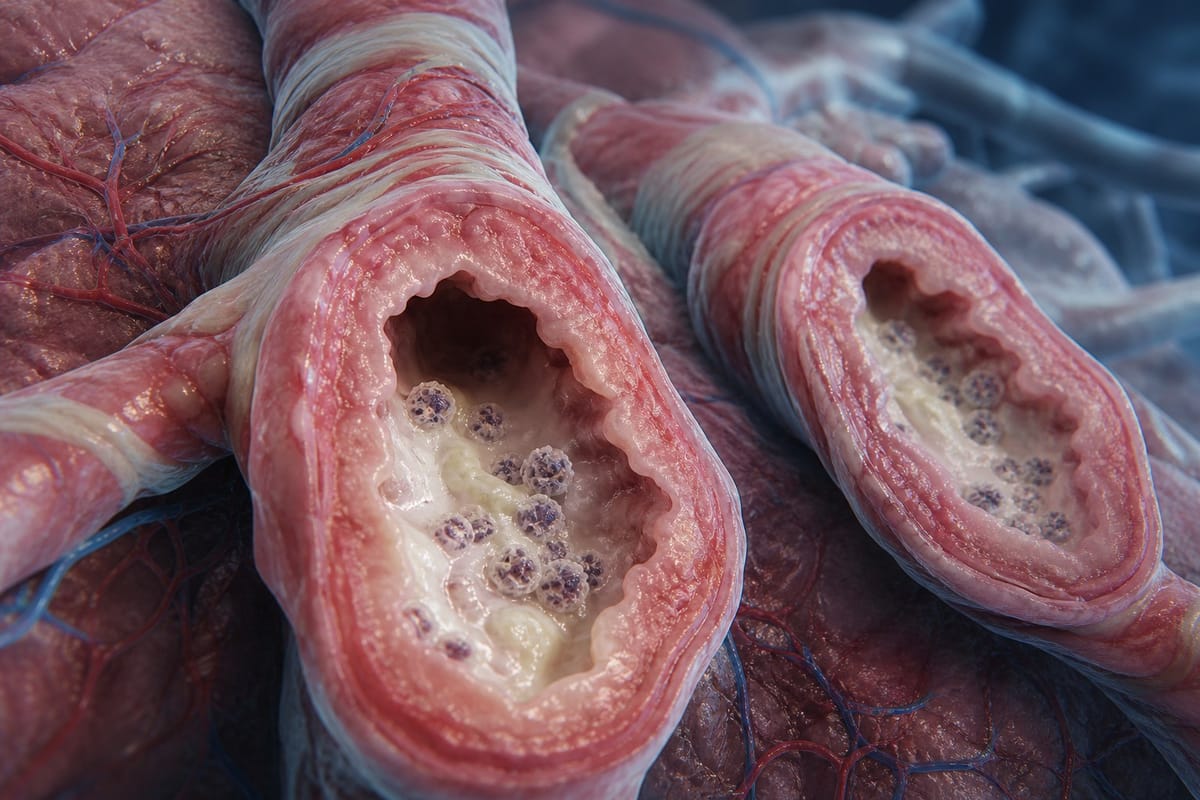
Roughly 500,000 US adults qualify for Brinsupri on label, but only about 32,000 are treated. That gap is the real subject of Sanofi's agreement, announced Nov 24, 2026, to buy Insmed for $175 per share in cash, an equity value of about $41.0 billion and a 46 percent premium to Insmed's unaffected close on Nov 18, before reports of a possible transaction. Both boards approved the deal, expected to close in the first half of 2027 pending an Insmed shareholder vote and US and other regulatory approvals, financed with debt and cash.
The drug sells. The funnel does not, yet
Brinsupri (brensocatib) is an oral, once-daily reversible DPP1 inhibitor designed to block activation of the neutrophil serine proteases that drive chronic airway inflammation in non-cystic fibrosis bronchiectasis. Approved in the US in August 2025, and also in the EU, UK and Japan, it is the first and only approved treatment for the disease. Commercially it has delivered: $1.09 billion in revenue through Sept 30, 2026, and $400.1 million in the third quarter alone, up 29 percent from the second quarter, with full-year 2026 guidance of $1.35 billion to $1.4 billion, according to the company's results.
The problem a $41 billion check cannot solve is diagnostic. Insmed's own investor presentation frames it as an untapped market: every patient must be found by a physician before a prescription exists, which makes commercial execution, not efficacy, the binding constraint on returns. Sanofi's projection of more than $10 billion in combined annual peak sales for the acquired medicines assumes that funnel opens.
The clock behind the deal
The urgency sits in Sanofi's own book. Dupixent generated 5.7 billion euros in the third quarter of 2026, nearly 40 percent of company sales, and the drug's main US compound patent expires in March 2031. Sanofi has said it has a vigorous defense planned and that formulation patents could extend protection, but the calendar is fixed. The purchase pre-funds that hole. Management expects the transaction to be accretive to business EPS by the end of 2028, with business operating income positive in 2027 and more than $500 million in annual cost synergies targeted.
What else is in the box
Insmed is not only Brinsupri. Arikayce, an inhaled amikacin, brought in $433.8 million in 2025 revenue, up 19 percent, and $124.4 million in the third quarter of 2026, up 9 percent year over year, guided to $460 million to $470 million for the full year. Its US approval is accelerated, based on sputum culture conversion, with clinical benefit not yet established and a boxed warning for respiratory adverse reactions. The FDA has accepted a supplemental application under priority review with a PDUFA target date of Jan 28, 2027, for use as part of a combination regimen in MAC lung disease.
TPIP, a once-daily dry powder treprostinil palmitil, is in Phase 3 for pulmonary arterial hypertension, pulmonary hypertension associated with interstitial lung disease, and progressive pulmonary fibrosis, with an IPF Phase 3 planned for the first half of 2027. It is not approved anywhere, and Insmed's deck sizes its four target indications at about 450,000 diagnosed patients across the US, EU5 and Japan. Brensocatib's case outside the lung has already failed once: in April 2026, Insmed discontinued the program in hidradenitis suppurativa after its Phase 2b CEDAR study missed primary and secondary endpoints; at week 16, total abscess and inflammatory nodule counts fell 45.5 percent on the 10 mg dose and 40.3 percent on the 40 mg dose, against 57.1 percent on placebo.
Doing the arithmetic
On disclosed guidance, the two marketed products reach roughly $1.8 billion combined in 2026, which puts the price at about 22 times 2026 guided product sales, and at more than $10 billion of peak sales it is under 4.1 times peak. Those are simple multiples on disclosed figures, not forecasts. Jefferies models Brinsupri at $6.8 billion and Arikayce at $1.3 billion in 2035 and flags AstraZeneca's tozorakimab as a bronchiectasis competitor. Markets reacted on the news: Insmed closed up 14.1 percent at $170.15 and Sanofi rose 10.9 percent in Paris, in what is the largest pharma acquisition since Pfizer bought Seagen for $43 billion in December 2023.
What to watch now is procedural and then commercial: the shareholder vote, the Jan 28, 2027 PDUFA date for Arikayce, TPIP enrollment across three Phase 3 programs, and whether the treated population moves meaningfully above 32,000. The premium was paid for a future in which diagnosis catches up to approval.