Merck's TROP2 ADC Met the Survival Endpoint and Missed on Progression
Merck's sac-TMT met overall survival in gastroesophageal cancer that had already failed two lines of therapy, but missed progression-free survival, and the company disclosed no hazard ratio. The gap between those two results is what regulators will have to read.
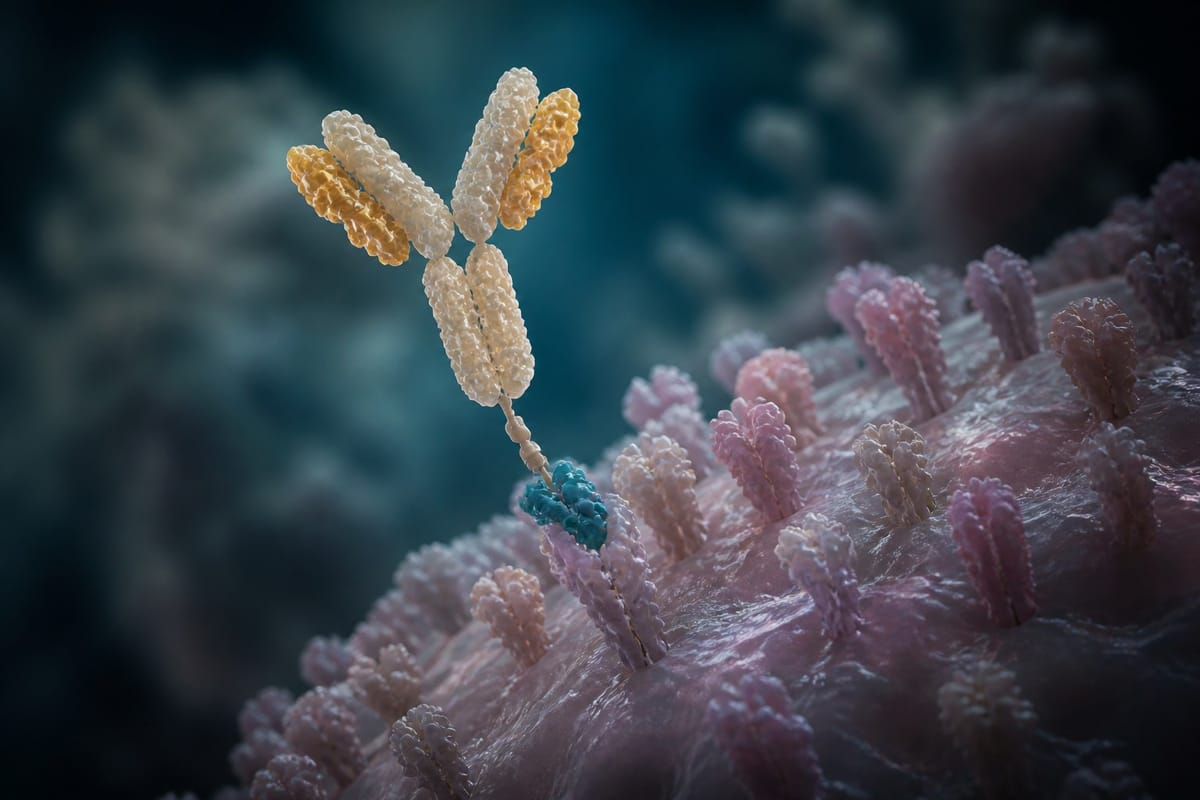
In gastroesophageal cancer that has already failed two lines of therapy, the benchmark is a drug that added 2.1 months to median survival over placebo. On November 20, Merck announced that its TROP2-directed antibody-drug conjugate, sacituzumab tirumotecan, cleared the harder version of that bar, beating active physician's choice therapy on overall survival in the Phase 3 trial called TroFuse-015. Then, in the same release, the company reported that the trial missed progression-free survival.
The study enrolled 473 people with locally advanced unresectable or metastatic gastroesophageal adenocarcinoma after at least two prior lines of systemic therapy. Against physician's choice of trifluridine-tipiracil, irinotecan, paclitaxel or docetaxel, Merck said the survival improvement was statistically significant and clinically meaningful, and generally consistent across subgroups regardless of TROP2 expression status. The safety profile matched earlier sac-TMT studies, with no new signals.
The number that was not there
Merck published no hazard ratio, no median survival figure and no p-value. It said the data will be presented at an upcoming medical meeting and shared with regulatory authorities. That is a normal sequence for a major readout, and it leaves the central question open.
The size of the effect matters more than usual here because the control arm is not a placebo. One of the physician's choice options is approved in this exact setting after two prior lines, on the strength of a randomized, double-blind trial in 507 patients in which it delivered median overall survival of 5.7 months against 3.6 months for placebo, a hazard ratio of 0.69, and a progression-free survival hazard ratio of 0.56. A drug that beats that comparator on survival has done something real. How much it has done depends on the hazard ratio that has not been released and the shape of the curve behind it.
A split result
A survival benefit with no progression-free survival benefit is a hard result to interpret, and the explanations are testable rather than rhetorical. Open-label trials can change how and when progression is detected, particularly when scans are read by central review. Treatment given after progression can extend life after a drug stops working, and the subsequent regimens patients received have not been disclosed. It also remains possible that the survival result is carried by a subgroup, or by a confidence interval wide enough to make the point estimate fragile. Objective response rate nominally favoured sac-TMT but was not formally tested under the prespecified analysis plan, so it cannot settle the question either.
None of this is visible from the announcement. All of it will be visible in the full dataset, which is why the medical meeting presentation carries more weight than such presentations usually do.
The same drug, a stricter result
Merck has run this experiment before with a cleaner outcome. In May, the Phase 3 study known as TroFuse-005 met both primary endpoints in advanced or recurrent endometrial cancer, overall survival and progression-free survival by blinded independent central review, at a prespecified interim analysis, and also hit objective response rate as a key secondary endpoint. That trial enrolled 776 patients against doxorubicin or paclitaxel.
Read side by side, the two results are a reminder that a molecule's performance belongs to a disease setting, not to the molecule alone. The differences that separate them include tumor biology, line of therapy and the strength of the comparator. TroFuse-015 is the second positive Phase 3 in a program that now runs 18 global Phase 3 trials and more than 15,000 patients, 14 of them pursuing first-in-class opportunities, so the platform is not in doubt. The reading of this particular trial is.
What the presentation has to settle
The patient population is not small. Merck's release cites about 31,500 new gastric cancer cases and 10,700 deaths from the disease in the United States in 2026, plus roughly 14,300 new esophageal adenocarcinoma cases, about 42% of them diagnosed after the cancer has already spread.
For those patients the relevant question is narrow. If the hazard ratio lands near 0.8, the survival win is modest and the progression-free survival miss will dominate the conversation. If it is closer to the 0.69 that the comparator itself achieved against placebo, Merck will be arguing that a drug which does not delay progression can still extend life, and will have to show what produced the gap. The survival result is real as announced. Its size, and whether the split can be reconciled, is what the data will decide.