The Multi-Billion Dollar Market Access Bet Biotech's Top Funds Just Made (NASDAQ: ENTX)
Ten of the most followed names in biotech investing funded Entera Bio two weeks ago through its pivotal trial of EB613. Understanding the potential these investors see in Entera requires understanding the Company’s lead asset and how it could transform the way osteoporosis patients are treated.

On July 27, Entera Bio (NASDAQ:ENTX) priced an oversubscribed $275 million private placement at $2.04 per share. The round was led by BVF Partners, which first bought in through a $10 million private placement in April. Behind it came a roster of top tier biotech investors: RA Capital, Perceptive Advisors, Venrock Healthcare, Vivo Capital, TCGX, Longitude, Driehaus, Logos and Catalio. For a company valued at approximately $100 million the day before the financing, that is more than two and a half times the company’s entire market value, arriving in a single round.
A check that size from this caliber of investors into a rather under the radar biotech is a statement about Entera, its lead asset EB613, its potential market size and the scale of the opportunity they see in it. The company reported second-quarter results and a business update on Friday.
Two kinds of drugs, and a majority who take neither
To understand the multi-billion value these funds appear to be eyeing for Entera, we need to break down how osteoporosis is treated today, and why most patients are not treated at all.
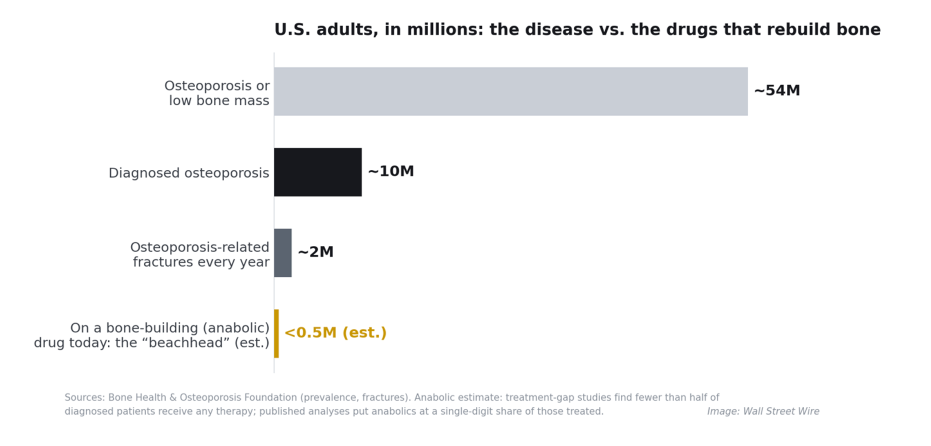
Osteoporosis quietly thins bone until it breaks. About 10 million Americans have the disease and another 44 million have low bone mass, per the Bone Health and Osteoporosis Foundation, driving roughly two million fractures a year. One in three women over 50 will break a bone because of it.
Medicine offers two kinds of drugs. The first, anti-resorptives such as generic bisphosphonates and Amgen's (NASDAQ:AMGN) Prolia, slow the breakdown of old bone. These are first-line, but they do not rebuild bone that is already lost and they do not restore the skeleton like an anabolic drug. Prolia became a $4.4 billion drug since it is effective and accessible, requiring only two shots a year, but it carries a risk of rebound vertebral fractures if discontinued. Most patients, however, start on bisphosphonates: oral, generic, cheap, accessible. About half of patients abandon bisphosphonates within a year, mostly over GI side effects, even though the class takes the lion’s share of prescriptions.
The second class, anabolics, actually builds new bone and more importantly restores the skeleton. These are more efficacious agents which can better manage patients with osteoporosis. Published estimates however put anabolic use at a single-digit percentage of treated patients. This is where the paradox lives. Every approved anabolic requires injections: daily self-injections for Lilly's (NYSE:LLY) Forteo and for Tymlos, in-office injections for Evenity, prescribed largely through specialist channels built around refrigeration, injection training and buy-and-bill and reimbursement red tape for patients and caregivers. For a disease with no symptoms until a bone breaks, asking a 68-year-old woman to inject herself every day is a hard sell.
Run the numbers and the picture is stark: treatment-gap studies find fewer than half of the 10 million diagnosed receive any therapy, and anabolics' single-digit share of that group leaves fewer than half a million Americans on a drug that rebuilds bone. The available oral bisphosphonate drugs are often discontinued due to their side effects and the strongest drugs reach almost no one.
The beachhead is already worth billions. EB613 aims at everyone beyond it.
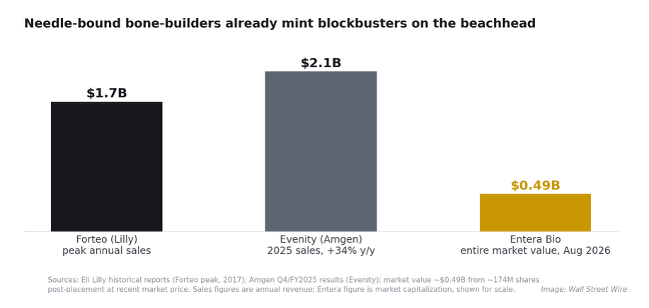
It seems reasonable to call today's anabolic market the 'beachhead'. But even confined to the needle, it mints blockbusters: Forteo peaked at approximately $1.7 billion in annual sales in 2017, and Amgen's Evenity grew 34% last year to $2.1 billion, a bone-builder that still requires two injections in a doctor's office every month.
But, the bigger prize sits beyond the beachhead. With roughly 10 million diagnosed Americans, and roughly 200 million women worldwide estimated to have osteoporosis, every one percent of the U.S. population alone is about 100,000 patients, and the untreated majority runs into the millions. By some estimates, fewer than 40% of diagnosed patients accept any of the available drugs on the market.
Entera's lead program, EB613, is a once-daily oral tablet of PTH(1-34), the same anabolic peptide as Forteo. A tablet needs no refrigeration, no injection training and no specialty channel; it could be prescribed by the primary care physicians and gynecologists who actually manage these women. That would not modestly enlarge the anabolic market. It could multiply it.
Seen through that lens, $275 million starts to look like a very reasonable price, a price that many of the most sophisticated funds in biotech evidently agreed with.
Even after the raise, the entire company is valued at under $500 million, less than a third of Forteo's best single year of revenue. If Prolia could attain a $4.4 billion run rate, it is fair to ask what an effective anabolic tablet could achieve. That potential payoff, if an oral anabolic does to this market what pills have done elsewhere in medicine, is what these investors appear to be underwriting.
What the money is buying into
EB613 rapidly produced statistically significant bone density gains in a 161-patient Phase 2 study published in the Journal of Bone and Mineral Research. In June, the FDA gave positive feedback on the registrational plan: a single 12-month Phase 3 in approximately 750 patients, built on the total hip bone density endpoint regulators formally qualified in December 2025. The study is expected to begin late this year, with topline targeted for the second half of 2028. Per the company, the raise fully funds the program through NDA submission and supports operations into 2030.
And EB613 is only the tip of the iceberg. The same oral platform sits behind EB612, an oral PTH replacement for the rare disease hypoparathyroidism now advancing into Phase 1, with an IND filing targeted for the first half of 2027 per the company’s latest update, in a market where Ascendis Pharma's (NASDAQ:ASND) daily PTH(1-34) injection Yorvipath generated roughly €477 million in 2025 while Ascendis’s own market value climbed from roughly $4 billion in 2022 to more than $16 billion today. Behind that: an oral GLP-1/glucagon tablet for obesity and an oral GLP-2 program for short bowel syndrome.
The setup from here
The catalyst path is legible: Phase 3 initiation late this year, catalysts all through 2027, an EB612 IND targeted for the first half of 2027 as well, and pivotal data expected in the second half of 2028. Drug development carries real risk, and neither regulatory alignment nor a funded balance sheet guarantees a successful trial. But the July syndicate has already answered the question that sinks most small-cap biotechs, who will pay to find out. What remains open is the question the market has yet to answer: how large does the bone-building market become once a needle is no longer required?
Read this next >> Fixing the Signal: What Orzeyful's FDA Approval Means for Narcolepsy and the Orexin Era
Recent news highlights from Entera
Entera Announces Second Quarter 2026 Financial Results and Business Updates
Entera Bio Phase 2 Data Supporting EB613’s (Oral PTH(1-34)) Anabolic Effect on Postmenopausal Women with Osteoporosis at High Risk for Fracture Selected for Plenary Poster Session Presentation at the ASBMR 2026 Annual Meeting
Entera Bio to Participate in the Canaccord Genuity 46th Annual Growth Conference
Entera Bio Announces Pricing of Oversubscribed $275 Million Private Placement
Important Disclaimers and Disclosures: The author, Wall Street Wire, is a content and media technology platform that connects the market with under-the-radar companies. The platform operates a network of industry-focused media channels spanning finance, biopharma, cyber, AI, and additional sectors, delivering insights on both broader market developments and emerging or overlooked companies. Wall Street Wire is not a broker-dealer or investment adviser. References to market size estimates, valuations, price targets, or other third-party data are provided strictly for informational purposes. Market size figures, research estimates, or other third-party data referenced in this article are quoted from publicly available sources believed to be reliable; however, we do not independently verify or endorse them, and additional figures or estimates may exist. Wall Street Wire receives cash compensation from Entera Bio Ltd. (the "Issuer") for coverage and awareness services, which are provided on an ongoing subscription basis. The content above is a form of paid advertising and promotion and is for informational purposes only and does not constitute financial or investment advice. This article may contain forward-looking statements about the Issuer's products, plans, or prospects that are subject to risks and uncertainties; actual results may differ materially, and readers should review the Issuer's public filings on SEC EDGAR (sec.gov/edgar) for full risk factors. Full compensation details, information about the operator of Wall Street Wire, and the complete set of disclaimers and disclosures applicable to this content are available at: wallstwire.ai/disclosures. This article has not been reviewed or approved by the Issuer prior to publication and should not be considered an official communication of the Issuer. Images may be computer generated and are for entertainment and visualization purposes only, and may not be an accurate or exact depiction of the technology.