Alpha Tau's Head-and-Neck Data Tomorrow Confronts a Blind Spot in One of the World's Best-Selling Cancer Drugs
Merck's $31.7 billion oncology drug has transformed oncology, but combining immunotherapy with radiation remains a major challenge. Tomorrow, Alpha Tau will present the first prospective data testing whether its targeted alpha radiation can change that equation.


Tomorrow morning (July 21, 2026) in Boston, Alpha Tau Medical Ltd. (Nasdaq: DRTS) will step to the podium at a major head and neck cancer conference to answer a question that has quietly frustrated oncologists: can you actually make Keytruda work better with radiation, or does the radiation cancel out the drug?
The drug is pembrolizumab - Merck's Keytruda, which generated $31.7 billion in 2025, more than any medicine in the world. The patients are the ones Keytruda struggles with most: elderly people with locally advanced or metastatic head and neck cancer, too frail for chemotherapy, often getting Keytruda alone as their only option.
The blind spot
Keytruda releases the brakes on the immune system so the body's T cells can attack cancer. It is approved in more than 40 U.S. cancer settings. In head and neck cancer, doctors often add radiation to weaken the tumor locally and help the immune system recognize the disease elsewhere in the body.
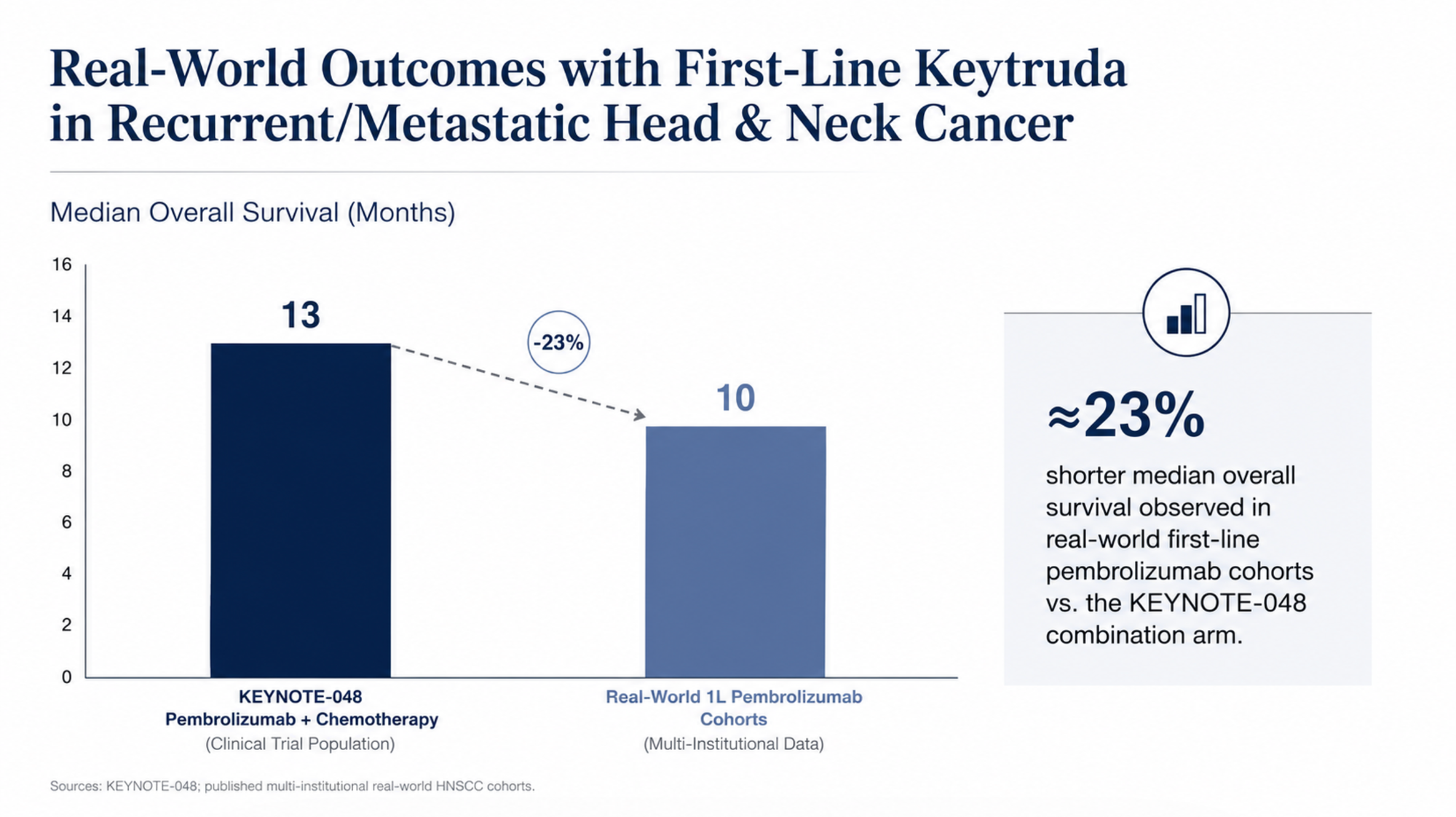
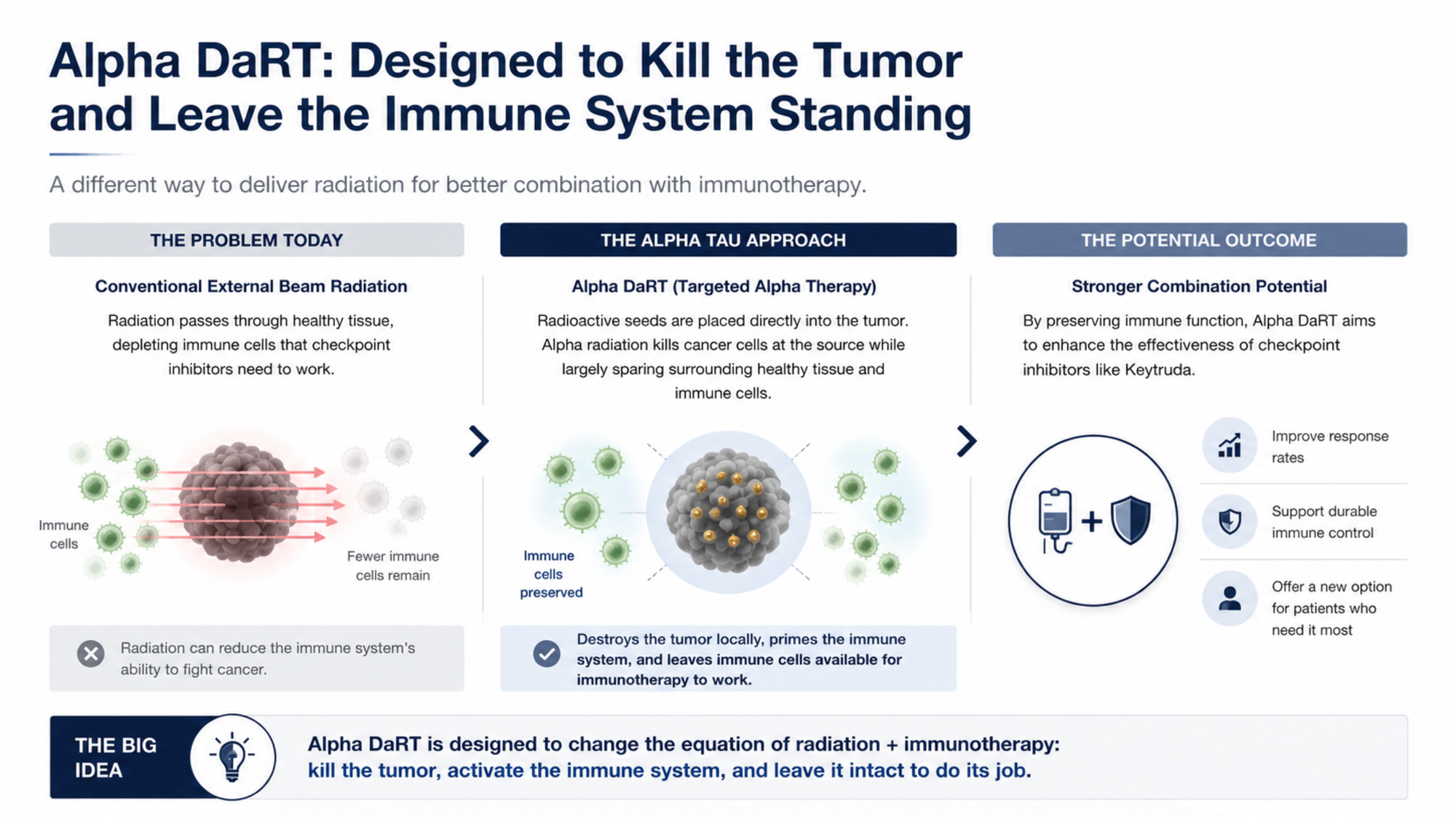
In theory. Conventional radiation, fired through the body from outside, also depletes the very immune cells Keytruda needs. In a fit 60-year-old that trade-off may not matter. In a frail 80-year-old it can. Real-world outcomes on first-line Keytruda in recurrent or metastatic head and neck cancer have reported median overall survival around 10 months in multi-institutional cohort data, versus roughly 13 months in the KEYNOTE-048 pembrolizumab-plus-chemotherapy arm.
That gap is the blind spot. It is the question Alpha Tau's data is built to test.
A different way to deliver radiation
Alpha DaRT does not fire beams. Tiny seeds impregnated with radium-224 are placed directly inside the tumor. As the radium decays, high-energy alpha particles destroy cancer cells at close range, and the radioactive daughters diffuse only millimeters before decaying themselves. The lethal radiation stays inside the tumor. The surrounding healthy tissue - including nearby immune cells - is largely spared.
The combination pitch - kill the tumor locally, prime the immune system through cell death, and leave the immune army standing for the drug to work with. In January, at ASCO GI, Alpha Tau reported that pancreatic cancer patients treated with Alpha DaRT - a disease notorious for immune suppression — showed no significant deterioration in key immune markers one month after treatment. A monotherapy signal in a different cancer, but a signal.
What is being presented
Tomorrow's data comes from a study at Hadassah Medical Center in Jerusalem in elderly patients with locally advanced or metastatic head and neck squamous cell carcinoma. Each received Alpha DaRT placed directly into the tumor alongside standard pembrolizumab. The abstract was selected for a podium, not a poster, at the American Head and Neck Society's 12th International Conference. Alpha Tau has said the presentation will include complete top-line results.
The metrics to watch: tumor response rates, safety in a fragile population, and any signal about the immune environment before and after treatment. Patient count will be small. But this is the first prospective read of Alpha DaRT and a checkpoint inhibitor used in the same patient.
Not a one-off catalyst
The July 21 presentation lands in the middle of Alpha Tau's busiest twelve months to date.
In February, Japan granted the company's first marketing approval outside Israel, for Alpha DaRT in unresectable head and neck cancer - the same disease being studied tomorrow. In May, interim data from the U.S. REGAIN trial in recurrent glioblastoma showed 100% local disease control in the first three patients, with two seeing tumors disappear completely on MRI. The FDA subsequently cleared enrollment of the remaining patients and added two U.S. sites.
Also in May, Alpha Tau finished enrolling its first U.S. pivotal trial - the 88-patient ReSTART study in recurrent skin cancer, with top-line data expected later this year and the first module of a modular PMA application already submitted. On July 15, the company treated the first immunocompromised patient at Banner MD Anderson in a separate skin cancer study, ADMIRE, aimed at transplant recipients and others who cannot receive checkpoint inhibitors at all.
In June, Tolmar - an established U.S. urology and oncology company - signed a 20-year agreement to commercialize Alpha DaRT in prostate cancer: $15 million toward manufacturing, a $20 million equity investment at a 25% premium to the 30-day trading average, up to $161.5 million in milestones, and an option to expand to bladder.
Alpha Tau makes its own sources in-house and last year received a radioactive-material license for its New Hampshire facility, with first-phase capacity of roughly 400,000 sources. Alpha DaRT holds FDA Breakthrough Device Designations in skin, oral cavity, and glioblastoma indications.
If tomorrow's head and neck data is clean, it strengthens the biological case that Alpha DaRT can layer on top of checkpoint inhibitors without undermining them. Keytruda is approved in more than 40 indications. Every one is, in principle, a setting where a radiation therapy that leaves the immune system intact could be worth studying in combination.
The presentation begins at 10:30 AM Eastern.
Read this next >> The Pill That Could Retire the Needle: What Lipfendra's Approval Means for Cholesterol Medicine
Recent news highlights from Alpha Tau
Important Disclaimers and Disclosures: The author, Wall Street Wire, is a content and media technology platform that connects the market with under-the-radar companies. The platform operates a network of industry-focused media channels spanning finance, biopharma, cyber, AI, and additional sectors, delivering insights on both broader market developments and emerging or overlooked companies. The content above is a form of paid promotional content and advertising. Wall Street Wire receives cash compensation from Alpha Tau Medical Ltd or a related party for ongoing coverage and awareness services. This content is for informational purposes only and does not constitute financial or investment advice. Wall Street Wire is not a broker-dealer or investment adviser. Full compensation details, information about the operator of Wall Street Wire, and the complete set of disclaimers and disclosures applicable to this content are available at: http://wallstwire.ai/disclosures. Market size figures or other estimates referenced in this article are quoted from publicly available sources; we do not independently verify or endorse them, and additional figures or estimates may exist. This article should not be considered an official communication of the issuer.